
Writers Who Run: An Interview with Nicholas Triolo
By Malissa Rodenburg
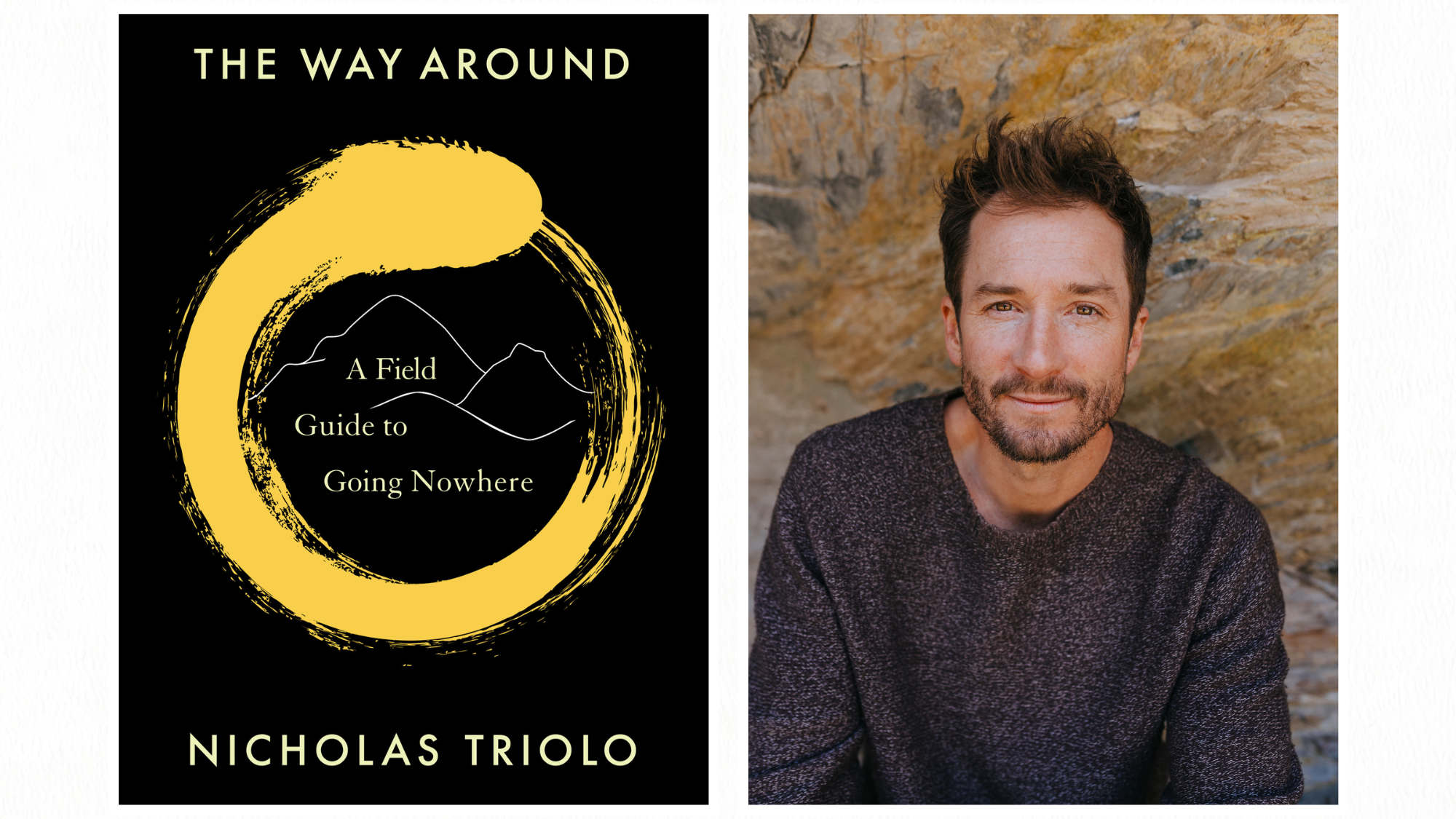
I was thinking about the latest Writers Who Run subject while I slogged on the treadmill the other evening. The book is “The Way Around: A Field Guide to Going Nowhere” by Nicholas Triolo.
Running on the treadmill can feel a bit like going nowhere and all I can muster after I put my daughter to bed is two, maybe three miles. Well-meaning acquaintances ask me what I’m training for and all I can do is shrug. Yet, I’m reminded, as I stare at what could be mold spores on the inside of the garage door, the humming belt below my feet, that sometimes we don’t know where our training will take us. And all those beautiful, hard miles along the coasts or mountain vistas may ultimately lead you to the most meaningful moments in a cold, cluttered garage while your child sleeps. Or 20 miles along a hazardous Superfund site, as it did for Triolo. In the end, you stop where you started.
“The Way Around” details three specific expeditions. In each, the goal was not to summit the mountain, but to circle it. Through Triolo’s travels he was drawn to the Tibetan meditative practice of Kora, which focuses on revolving. This led him to Mount Kailash in Tibet, Mount Tamalpais in California, and the Berkeley Pit in Montana.
The book circles many themes, too. In the people Triolo meets along the way, he circles an understanding of living contradictions in humanity and in nature. In detailing his history as a high-achieving athlete from a family of athletes, he circles the innermost drive to accomplish and what it takes to quiet those thoughts. He also thoughtfully circles the natural history of each place visited in the book.
In his words: “I am constantly reminded by these circumambulations that every path is cobbled in bone, perpetual beginnings and endings, and to steward such ecological violations at this hyperobject motion–ocean acidification, climate change, nuclear waste storage–all of it offering mirrors to our own hubris.”
There’s really nothing else I’ve read like this.
In December, I sat down with Triolo to talk about this eco-adventure memoir and spiritual guide, as well as his loosening pursuits as an ultrarunner, and our shared distaste for fake plants.
This interview has been edited for length and clarity.
In these interviews, I am often talking with people who use running as a way to come to the page. Whereas, it seems like you are brought to your physical practice via literature, whether that’s through the poetry of Gary Snyder or the religious texts you reference in “The Way Around.” How do you see the mental practice of writing connected to your physical pursuits?
They're so deeply connected. I don't actually know what it would feel like to have one without the other. My physical practice is really a counterbalance to the more cerebral. It really helps to open the pores for me. I literally don't know what it would feel like to not have a movement practice.
So much of the discipline or the infrastructure, the architecture, the scaffolding, that I've figured out how to hang all my training on for running, I guess, has also really become helpful in the discipline of writing every morning. You have a goal race or something, and you sort of reverse engineer it. How do I build? How do I develop my body to absorb the necessary musculoskeletal stress so that when I get to race day, it won’t be completely unfamiliar. I’m not necessarily a type A person by nature, but I think running and the practice of training has actually bled into just getting word count done and the gamification of it in preparation for an end goal, whatever that is, whether it’s a book proposal or pitching a magazine.
Can you elaborate on what your creative process was like for this book in particular?
It came in fits and starts. It felt seasonal, in some ways, where I would have a six month chapter where I would be getting up every morning, and I had to be writing, or revising, editing. It's sub 50,000 words. It's a pretty short book. It was actually almost twice as long at some point. It was a very big draft. So there was a lot of overwriting and then a lot of pulling back and that, to me, feels like a pretty effective approach to writing and drafting, is that you feel at liberty to go way over a word count. And then you start looking at things and you’re like, ‘What’s necessary? How is this all fitting?’
Another thing I'll say on that note is that there are three big parts of this book, which is a pretty classic structure to a book, but there were, at one point, seven. And through working with [the publisher] Milkweed, they were really helpful in asking the question like, ‘What are the most necessary parts to include? Not only because they're interesting, but how do they actually answer the deepest questions that you're trying to ask?’ And I would recommend that to anybody. The more honest you can be about the deepest question of your book, the yearning, the longing–that actually helped build a rubric for what to include, what not to include.
Each of the three pilgrimages that ultimately were included in the book felt circular in themselves. And tended to circle each other. The first–Mt. Kailash–seemed physically to be the hardest. Subsequently, it seemed to get easier physically and harder mentally, emotionally. I’m wondering if that was intentional?
One of the things I wanted to do–and I'm not sure if I succeeded or not–was to invite people to a specific landscape in all three of these stories. In the first part, for example, we're headed to the western Tibet, to Mt. Kailash, and you're learning about this mountain and this practice, but then as you're actually kind of entranced by the place, you're starting to meet and learn about a particular character. In the first one it’s Pierre, the second one it’s Laura, and the third one it’s Joe. They end up actually becoming sort of parallel gravitational centers. You come for the mountain and you stay for the humanity. You end up sort of doing this circular dance around an emotional story, or your emotional body becomes involved and incorporated into the laps.
In the book, you get into your relationship with ultrarunning and how that’s evolved from a relentless pursuit into something more holistic. It sounds like you’re going into races without so much expectation. Is that right?
I just shared a donut with Brendon Leonard from Semi Rad. He's a friend of mine here in Missoula. Anyway, we had these big apple fritters. And he's like, ‘Man, you could probably just run a 50k eating only one apple fritter. Do you think you could do that?’ And I might actually try this. But I think that part of me is approaching this thing we call running, and this thing we call competition, with a lot more levity and a lot more play.
I've done a lot more long distance fast packing and less obsessive training. My whole year isn’t a training plan. And that feels a lot more spontaneous and a lot more inclusive of other people’s lives. I find that I am able to make plans with and join friends and my partner on adventures that are not working themselves around my life and my schedule, which was once a thing.
It feels helpful to go fallow for a few months and just play. I'm writing a little fiction, and just reading a ton and reading other people's work and taking notes and and just tracking patterns of curiosity right now.
So, are you working on anything structured right now?
A lot of like, weird chicken scratch in my journal and bad poetry. I've been tracking this weird obsession around the emergence of fake nature–fake flowers, fake trees. I interviewed this woman who installs fake ferns and flora in corporate offices in the Bay Area. It’s a whole business of mimicking nature to evoke a feeling of awe and comfort with these plants that you never get close enough to understand are actually not real. It brings up all these questions for me about authenticity. I’ve been writing a very strange short fiction piece around that.
That's so funny. I feel kind of offended when I see fake plants. I don't know why.
No, I do too. I'm actually looking out my window, and I think I'm looking at some sort of fake Christmas flora, because I’m in the Northern Rockies in Montana, and nothing's blooming. I share that aversion. I get sort of defensive of the ephemeral nature of beauty. Mortality is what makes things shimmer. And if we aim towards a simulacrum of experience, I don’t know what that does to have us be engaged with the stakes of being human, of being creatures of expiration. And there's a whole movement happening right now in reverse aging, of course, and so it's bigger than fake plants. I'm trying to understand what it does to the human psyche to consider immortality.
Speed Work:
In one word, what is “The Way Around” about?
Intimacy.
Where is your favorite place to run in Montana?
The first piece I ever got published outside of running media or outdoor media, was a story about this little mountain here in the Missoula Valley in western Montana. It's called Mount Jumbo, and it looks like Jumbo the elephant. It's this beautiful, easy, kind of five mile up and down and around. There's a summit, but there's also this beautiful ridge that you don't even have to get to the summit. And anyone that reads my book will realize that summits are sort of fraught in my experience with landscapes. (And also, I'm not canceling summits in this book, I also love summits. High points are great.) But on the way to the Jumbo high point, there’s a ridge line that takes my breath away almost every time. You can see the Missoula Valley, which has this old glacial lake, and you can see the Rattlesnake Wilderness to the North and it’s just a stunning place right here in town.
And also–this is resonant with my book–is that from December to May, it’s off limits to humans because of the elk migration. I love that. It’s a good thing culturally, to see something that’s hands off in the landscape.
Where is your favorite place to run anywhere in the world?
I have two tied for first, maybe three. There's a 93-mile circuitous path that goes around Mount Rainier called the Wonderland Trail. I used to guide trips around it. I’ve gotten to know that landscape quite well. During July, August, September, it’s just stunning. Lots of water, wildflowers, berries.
The other place I’ll say is Forest Park in Portland. I used to live in Portland and it’s kind of where I started running. Forest Park is an urban wilderness. It’s totally in the city of Portland, but still like an incredibly magical place to run.
And then the last thing I’ll say is I’ve run this race called the Transalpine Run in Europe, which is a 200-mile race that crosses the Alps. It’s a stage race, so you’re running like 18 to 20 miles every day over a week. You do it with a partner. It’s some of the most stunning running I’ve ever done, by far, in the Austrian Alps and Switzerland. It’s complete decadence.
If you could go on a run with any of your subjects, who would you choose?
I'm gonna go ahead and say Robert Macfarlane. [He] is one of my heroes. He just wrote this really exquisite book called “Is a River Alive?” I had the great privilege of being in conversation with him at the start of this book launch during his book tour in the U.S. He's from Cambridge, and he's also a runner and he's one of my favorite writers in the narrative nonfiction, environmental writing world. Highly recommend all his books. And we talked about going for a run together, and we haven't yet. That would be a dream of mine.
What are you reading right now?
I'm reading more fiction these days. I'm reading “A Ghost in the Throat,” by [the] Irish poet Doireann Ní Ghríofa. It's a strange book, nonlinear in nature, sort of like a haunting poem that travels through time. And then I'm also reading “The Fifth Season” by NK Jennison, which is fantasy in some ways, which is not the genre that I normally am into. It's Black futurism. I'm just getting into it, and it's stunning.
Learn something new? Find a new book you can’t wait to crack the spine of? Consider buying the columnist a coffee.
Writers Who Run is a monthly column by Seattle-based reader, runner, writer, and bookseller Malissa Rodenburg.